

Cloudy Pool Water - Causes & Solutions
Cloudy Pool Water: Causes, Cures & Prevention
Why you can't see the bottom of your pool — and how to fix it

You head out for a morning swim and instead of sparkling blue water, you're greeted by a murky, hazy pool that looks more like milk than an inviting oasis. Cloudy pool water is one of the most common complaints we hear at Poolwise Padbury — and while it's frustrating, it's almost always fixable once you understand what's causing it. The key is diagnosis. Cloudy water is a symptom, not a disease, and treating it effectively means finding the root cause.
Why Cloudy Water Matters
Beyond the obvious aesthetic problem — who wants to swim in that? — cloudy pool water can indicate serious issues with water quality and safety. When you can't see the bottom of your pool, you can't see a struggling swimmer either. It's a genuine safety hazard.
Cloudy water often harbours higher levels of bacteria, can damage pool surfaces through scaling, corrode equipment, and generally indicates that your sanitiser isn't working effectively. If your pool is cloudy, something is wrong — and leaving it will only make things worse.

This is what we're aiming for — crystal clear water where you can see every tile on the pool floor
The Four Main Culprits
Cloudy pool water almost always comes down to one (or a combination) of four issues: filtration problems, water chemistry imbalance, low sanitiser levels, or environmental contamination. Let's break each one down.
1. Poor Filtration
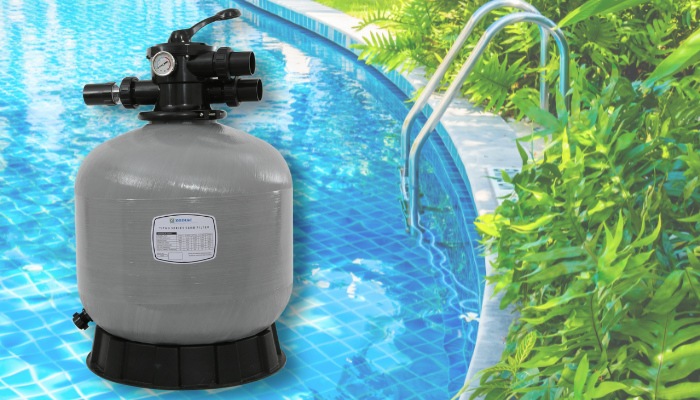
This is the number one cause of cloudy pool water, and the first thing we check. Your filter's job is to remove particles from the water — if it's not doing that job properly, cloudiness is inevitable.
Common filtration problems include:
- Not running the pump long enough — In Perth's summer, you need 8–10 hours of filtration daily. A good rule of thumb: add one hour for every 10°C above 15°C. So on a 35°C day, aim for 10+ hours.
- Dirty or clogged filter media — Sand filters need backwashing when pressure rises 8–10 PSI above normal. Cartridge filters need cleaning every few weeks. Old filter media (sand over 5 years, cartridges over 2 years) loses effectiveness.
- Pump or circulation issues — Blocked skimmer baskets, clogged pump strainers, or failing pump impellers all reduce water flow.
- Undersized equipment — If your system can't turn over the entire pool volume within 6–8 hours, your pump or filter may be too small for your pool.
💡 Quick Test: Check your filter pressure gauge. If it's 8–10 PSI higher than your "clean" baseline, your filter needs attention. No baseline? Write down the pressure after your next clean — that's your reference point.
2. Water Chemistry Imbalance
When your water chemistry drifts out of balance, it can physically cause particles to fall out of solution and suspend in the water. This is especially common with high pH, high alkalinity, or high calcium hardness — the "scaling" side of water chemistry.
Chemistry-related cloudiness:
- High pH (above 7.8) — Causes calcium to precipitate out as white, chalky particles. Also reduces chlorine effectiveness by up to 80%.
- High alkalinity (above 150 ppm) — Makes pH difficult to control and contributes to scaling and cloudiness.
- High calcium hardness (above 400 ppm) — Common in Perth with our bore water. Excess calcium forms visible white flakes that cloud the water.
- High Total Dissolved Solids (TDS) — When TDS exceeds 1500 ppm, water struggles to hold chemicals in solution. Often requires a partial drain and refill.
Ideal Water Chemistry Ranges
| Parameter | Ideal Range |
|---|---|
| pH | 7.2 – 7.6 |
| Total Alkalinity | 80 – 120 ppm |
| Calcium Hardness | 200 – 400 ppm |
| Cyanuric Acid (Stabiliser) | 30 – 50 ppm |
| Free Chlorine | 2 – 4 ppm |
3. Low Chlorine / Sanitiser Levels
When free chlorine drops below 1 ppm, bacteria and algae begin multiplying rapidly. The early stages of an algae bloom make pool water look dull, hazy, and slightly green-grey before the full "green pool" develops. If you catch it at the cloudy stage, you can prevent a much bigger problem.
Signs of sanitiser-related cloudiness:
- Pool walls feel slightly slippery or slimy
- Water has a dull, greyish-green tinge
- Strong "chlorine smell" (actually chloramines — combined chlorine — not free chlorine)
- Free chlorine tests below 1 ppm
⚠️ The Overnight Chlorine Loss Test (OCLT): Add chlorine in the evening after sunset, then test again first thing in the morning. If you've lost more than 1 ppm overnight, you likely have early-stage algae consuming your chlorine. Time to shock.
4. Environmental Contamination
Sometimes your pool chemistry and filtration are fine, but external factors have introduced contaminants faster than your system can handle them.
Common environmental causes:
- Heavy bather load — A pool party introduces sunscreen, body oils, sweat, and cosmetics that overwhelm your sanitiser and create insoluble compounds.
- Storms and heavy rain — Rainwater washes dust, pollen, bird droppings, fertiliser runoff, and organic debris into your pool. It also dilutes chlorine and can dramatically shift pH.
- Pollen season — Perth's spring and early summer bring heavy pollen loads that can cloud pool water quickly.
- Landscaping runoff — If garden beds or lawns drain toward your pool, you're getting a regular dose of phosphates, nitrates, and organic matter.
- Dust and wind — Our notorious Perth easterlies blow fine dust and particles directly into uncovered pools.

Beautiful landscaping can be a source of debris, pollen, and phosphate runoff
🔬 Fun Fact: The Science of Cloudiness
Pool water appears cloudy due to Rayleigh scattering — the same phenomenon that makes the sky blue. Tiny suspended particles (smaller than 1 micron) scatter light in all directions. Your filter can remove particles down to about 20–40 microns (sand) or 10–20 microns (cartridge), but those ultra-fine particles slip right through. That's where clarifiers come in — they clump tiny particles into larger ones your filter can actually catch.
How to Clear Cloudy Pool Water
The fix depends entirely on the cause. Here's a systematic approach:
Step 1: Test Your Water
Before you do anything else, get a comprehensive water test. Test strips at home give you a quick snapshot, but bring a sample into Poolwise for a detailed analysis — we test for parameters home kits often miss. You need to know your pH, alkalinity, calcium hardness, free chlorine, combined chlorine, stabiliser, and ideally phosphates.
Step 2: Balance Your Chemistry
Start with pH first (it affects everything else including chlorine effectiveness), then alkalinity, then calcium hardness. If your pH is above 7.8, bring it down first — high pH dramatically reduces chlorine effectiveness.
- Use hydrochloric acid or dry acid to lower pH and alkalinity
- Use sodium bicarbonate (buffer) to raise alkalinity
- Use soda ash to raise pH without significantly affecting alkalinity
Step 3: Check and Clean Your Filter
Clean your pump strainer basket, empty skimmer baskets, and service your filter:
- Sand filter: Backwash thoroughly until the sight glass runs clear. If it's been a while, consider a filter cleaner to remove oils and scale.
- Cartridge filter: Remove and hose down cartridges. Soak in filter cleaner solution overnight if heavily soiled.
- DE filter: Backwash and recharge with fresh diatomaceous earth.
Step 4: Shock If Needed
If chlorine is low, there's combined chlorine present, or you suspect early algae, shock the pool. Use calcium hypochlorite (granular shock) at 400g per 50,000 litres to raise chlorine to 10+ ppm. Run the filter continuously for 24–48 hours afterwards. If you've had visible algae, you may need multiple shocks over several days.
Step 5: Use a Clarifier or Flocculant
Once chemistry is balanced and chlorine is adequate, but water is still hazy with fine particles, it's time for a clarifier or flocculant.
What's the difference? A clarifier clumps tiny particles together so your filter can catch them — you keep filtering as normal. A flocculant clumps particles into heavy masses that sink to the pool floor, which you then vacuum to waste (bypassing the filter entirely). Floc is faster but uses more water; clarifier is slower but easier.
Recommended Products
Lo-Chlor Miraclear Liquid
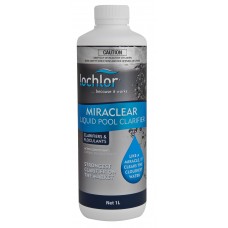
Arguably the strongest clarifier on the market. Uses a concentrated polymer resin that provides results in hours. Works with all filter types and can double as an alternative to alum-based flocculants.
Best for: General cloudiness, routine maintenance
Shop Now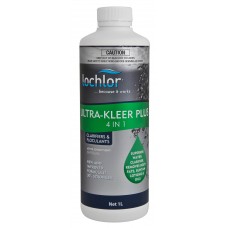
Lo-Chlor Ultra Kleer Plus 4-in-1
A natural clarifier that also eliminates body oils, sunscreen, and dissolved metals. Works in under 4 hours. Perfect after heavy pool use or parties.
Best for: Post-party cloudiness, oily water
Shop Now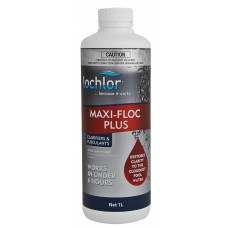
Lo-Chlor Maxi Floc Plus
Heavy-duty liquid flocculant for severely cloudy pools. Settles debris to the floor in 3–6 hours for vacuuming to waste. Specially formulated to work in salt water pools.
Best for: Very cloudy pools, post-algae treatment
Shop Now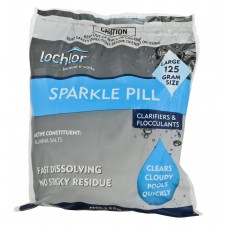
Lo-Chlor Sparkle Pills
Convenient flocculant tablets that sit in your skimmer box. Ideal for sand filters. Fast dissolving with no sticky residue. Great for ongoing clarity maintenance.
Best for: Sand filters, easy maintenance
Shop NowBrowse our full range of clarifiers and flocculants
Shop All Clarifiers & Flocculants⚠️ Important Notes on Clarifiers & Flocculants
- Don't overdose — More isn't better. Overdosing can actually reverse the charge on particles and make cloudiness worse.
- Flocculants are not for DE or cartridge filters — The floc will clog these filter types immediately. Use clarifiers instead, or vacuum to waste.
- pH matters — Flocculants work best with pH between 7.5–7.8. If pH is wrong, adjust it first.
- Kill algae first — Clarifiers and floc won't work if live algae is present. Shock the pool and eliminate the algae before clearing the dead particles.
Clarifier vs Flocculant: Which to Use?
| Factor | Clarifier | Flocculant |
|---|---|---|
| Speed | 4–24 hours | 3–6 hours |
| Method | Filter removes clumped particles | Vacuum settled debris to waste |
| Water Loss | Minimal | Significant (vacuuming to waste) |
| Filter Types | All types | Sand only (or vacuum to waste) |
| Effort | Add and filter — easy | Requires manual vacuuming |
| Best For | Mild to moderate cloudiness | Severe cloudiness, post-algae cleanup |
Preventing Cloudy Water
The best cure is prevention. Here's how to keep your water crystal clear year-round:

- Test water 2–3 times per week in summer
- Run your filter 8–10 hours daily in warm months
- Maintain pH between 7.2–7.6
- Keep free chlorine at 2–4 ppm
- Backwash when filter pressure rises 8–10 PSI
- Clean skimmer and pump baskets weekly
- Shock after heavy use or rain events
- Use a clarifier dose weekly as maintenance
- Manage phosphate levels (under 500 ppb)
- Brush walls and floor weekly
- Consider a pool cover to reduce debris
- Service your chlorinator cell regularly
When to Call the Professionals
Most cloudy pool situations can be resolved with the steps above. However, bring in professional help if:
- Cloudiness persists despite balanced chemistry and clean filtration
- You've tried multiple treatments without improvement
- Your pool has a persistent "chlorine smell" that won't clear
- Water has an unusual colour (brown, rust, or black tinge)
- You suspect equipment issues (pump not priming, filter not holding pressure)
- The pool has been neglected for an extended period
Still Looking at Murky Water?
Bring a water sample into Poolwise Padbury for a free comprehensive test. We'll pinpoint exactly what's causing your cloudiness and recommend the right solution.
Disclaimer: This guide is intended for general information purposes. Always read and follow product label directions carefully. Chemical dosages mentioned are approximations based on a typical 50,000-litre pool — calculate for your specific pool volume. If you're uncertain about any aspect of pool chemical treatment, consult a qualified pool professional. Poolwise Padbury accepts no liability for outcomes resulting from the application of information in this article.